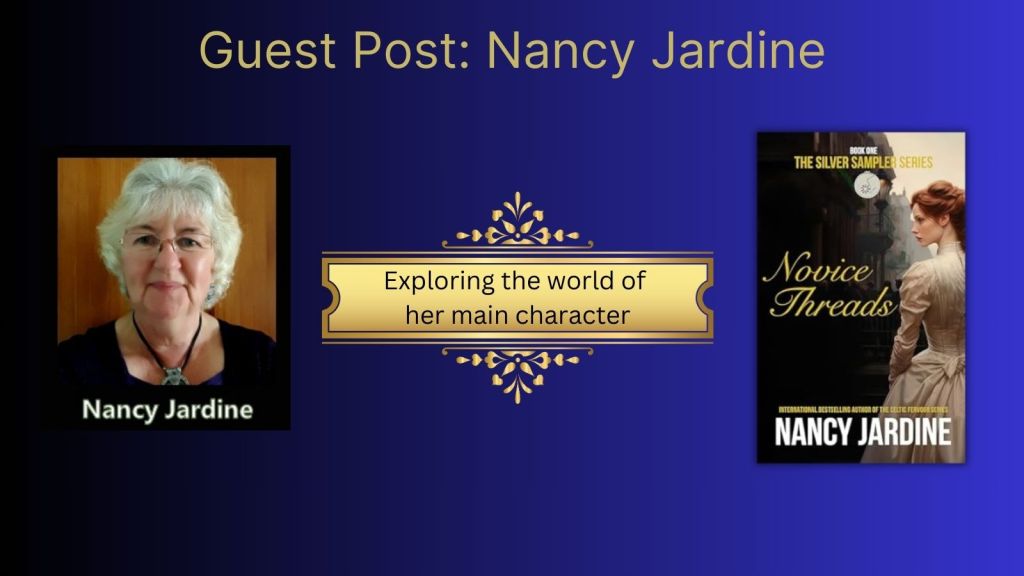
Today, I am delighted to have Nancy on my blog. An historical fiction author with many wonderful books to her name, Nancy kindly gives us some insight into the world of her main character, Margaret, in her newest release, Novice Threads.
Sharing is Caring
The phrase pops up on internet sites quite regularly but that’s not what my main character finds in Scotland during the 1840s when she is growing up…
Margaret Law, main character in Novice Threads (Book 1 of The Silver Sampler Series) loves words but she’d be confused by the above phrase. She spends hours wanting to know what everything means but at the tender age of five she’s stumped by things people around her say that don’t make sense. This is especially true when learning Victorian hymns, her parents being extremely devout churchgoers who drag her to services twice-on-a-Sunday with afternoon bible readings in between. However, Margaret instinctively knows that education is the key to a better future and that knowledge is essential.
A huge hurdle for Margaret is that few working-class girls are educated beyond a basic knowledge of reading and writing, and she craves so much more! Well before the 1840s, parishes in Scotland had to provide a schoolroom but that didn’t mean schooling was compulsory, or free. In general, sons were sent to the local school to learn to read, write and count, though some went well-beyond the basics so long as the quarterly fees for the dominie (schoolmaster) were paid. If educated at all, girls tended to go to a cheaper ‘Dame’ School, a facility that might teach basic reading skills but was designed to instruct girls in the arts of cooking, sewing, and how to housekeep. This was regarded as all girls required before they married and had their own home, or went into service in a larger domestic setting.
Little Margaret doesn’t know why she’s unlovable but she senses her parents have no real love to give her. William and Peggy run a local drapery shop in the rural mill-town of Milnathort. They’re not the poorest, yet money to spare is rare. Margaret is well-fed, well-clothed and with decent boots on her feet – unlike Margaret’s best friend Jessie who is the illegitimate daughter of a mill-worker. Yet, even at the age of five, Margaret knows she’d rather have the hugs and overt love that Jessie gets from her mother and grandmother, none of that ever coming Margaret’s way from her cold parents.
Margaret’s totally overjoyed when her father insists on paying for her to attend the local Subscription School. Peggy is against spending the money, claiming she can teach Margaret all she needs to know. William wins that particular argument, one of many acrimonious shouting-matches that Margaret has to listen to over the years. Declaring that since he has no son (and will never have one) Margaret must learn to read the Sunday afternoon bible readings.
Margaret is a little sponge soaking up knowledge as the years pass. She aspires to become a fully-fledged teacher though, in 1850, few women worked as certificated teachers in Scottish schools.
Everybody around Margaret knows how much Queen Victoria and Prince Albert love each other and they adore their large brood of children, but Margaret’s home situation seems entirely the opposite. William rarely shares anything with Margaret at all except for his religious views, and her mother isn’t much different. Her parents embrace new religious sects in pursuit of the ‘best doctrine’ for them, but Margaret is later to find that all is not as is seen on the surface with regard to her parents!
If he shared details of Queen Victoria, William might tell the curious young Margaret that Victoria was fifth-in-line for the monarchy when she was born in 1819. He might say that Victoria’s father, her grandfather, and two of her uncles would all have to die before she’d become queen. Margaret would be sad to learn that Victoria’s father died in 1820 from pneumonia, the well-known and brutal silent killer, before Victoria was a year old. However, William Law wouldn’t share particulars about Victoria’s grandfather being ‘the mad king’ who died almost immediately after her father. And explaining about the profligate and licentious Regency period from 1811 to 1820 would have been beyond the pale.

William Law wouldn’t be telling Margaret about King George IV’s mistresses, or about the monarch’s excessively lavish lifestyle. Those scurrilous ‘facts’ were definitely popular in some daily or weekly newssheets, but not in the ones William subscribes to.
And the next king, William IV? Nothing would be divulged about William’s illegitimate son by an unacknowledged mother, nor about King William’s long-term mistress, the ex-actress ‘Mrs Jordan’, who bore him ten children. Margaret might learn that King William eventually married at the age of 53 but had no surviving legitimate children, which was why Victoria became queen in 1837. Facts, yes, but never salacious ones.
Devastatingly, Margaret has to leave school before her twelfth birthday, circumstances forcing her parents to give up their drapery business. However, the job she gets as a tutor in Edinburgh, in a household where her friend Jessie works, is an incredibly good alternative to becoming a teacher. When her employer organises the use of a local lending library, Margaret learns far more about the monarchy and Victorian morality when she is exposed to some of those famous politically inspired ‘Punch’ cartoons in the weekly periodical which was started up in 1841, a cartoon style which imitated the earlier sketches from the late 1700s. Though Margaret could never take anything like a copy of Punch back to the Duncan house to devour during her own time, nor could she share such literature with her young pupil.
Unfortunately, Margaret gradually learns that the veneer of Victorian morality can be a sham. Her employers, the Duncans, hide many secrets, shames, and volatile situations – different to, but just as explosive as things her parents hide from her over the years. Growing up for young Margaret brings incredible joys but also terrible heartaches as she matures in a somewhat morally confusing Victorian society.

Buy Link: https://Mybook.to/NTsss
Author Bio:

If I’m not found staring into space beyond my desk (though some may call it my ‘thinking about/doing’ writing time) then the remainder of my week tends to be spent working in my garden, which always needs attention, or passing the time of day with my grandchildren who live next door.
Living in Aberdeenshire, Scotland, has great benefits because we can all pop out to visit a huge range of fabulous castles, standing stones, and other historical sites so easily – there being hundreds of sites to choose from – some within walking distance, or others a short drive away. Woodlands and Forestry Commission areas are also great for letting off some of that energetic steam which kids have in abundance. Fresh air is supposed to clear my ‘writing’ head, but I’ll let you know how that goes!
When I can find the time, I love to read an eclectic mixture of fiction genres, often reading into the wee small hours since my writing time tends to go on late and my reading for pleasure even later!
You’ll find me at the following places… and others across the internet.
Blog- http://nancyjardine.blogspot.com
Facebook Author page- https://www.facebook.com/NancyJardinewrites/
Pinterest- https://www.pinterest.co.uk/nanjar/
Twitter- https://twitter.com/nansjar


 Pam Lecky Books
Leave a reply to Pam Lecky Cancel reply